
Georgia VINE and Lee County
Georgia's Criminal Justice Coordinating Council announced the statewide automated victim-notification deployment on March 11, 2024. The official launch notice explains that the state uses Appriss VINE for real-time notifications. Alerts arrive by phone, online service, or mobile application. The service runs around the clock and supports multiple languages. It also connects with rights under Georgia's Crime Victims' Bill of Rights and Marsy's Law. For the web route, Georgia VINELink lets you find a person and, when an eligible record is available, register for custody notifications.
Statewide deployment does not mean every Lee County event appears automatically or immediately. No standalone county page promises a complete VINE feed. Select Georgia, then Lee County. Search for the person. Register separately once the correct record turns up. Viewing Citizen Connect alone does not create a VINE alert.
VINE reports custody information only, not a complete criminal history.
Check a Lee County Arrest
Start with a full name. An age, date of birth, booking number, or offender identifier helps even more. Those details cut the risk of picking the wrong person.
- Open the Georgia VINELink person search.
- Confirm Georgia and choose Lee County when a county or facility filter appears.
- Enter the name or identifier, then compare identifying details across possible matches.
- Open the matching record and review the reported facility and custody status.
- Use the separate registration option if you want supported custody-change notices.
Need the originating arrest record, charge wording, admit time, booking number, bond, or public photo? Use the Lee County recent-arrests guide. The official VINELink search screen shows the state, county, and person-search workflow.
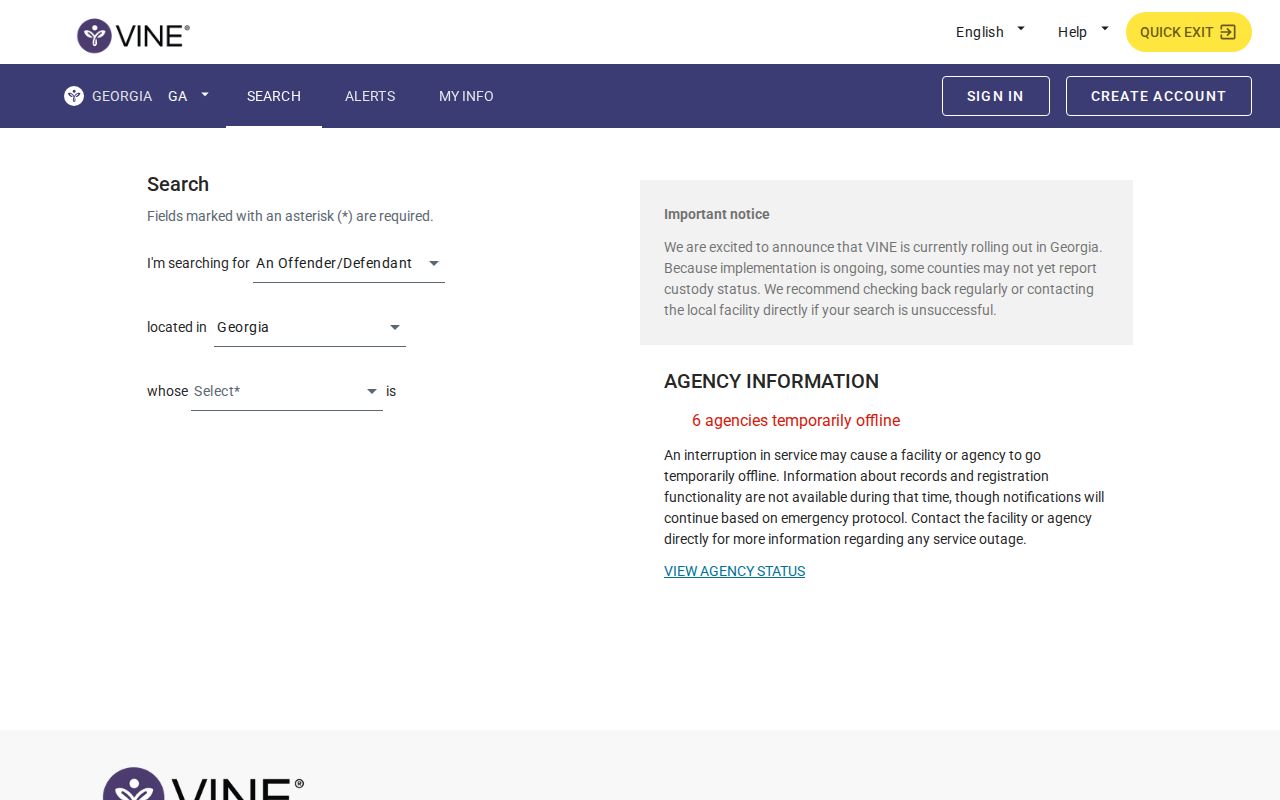
The official VINELink search screen explains the interface itself and does not show that any particular person is confined.
What a Custody Result Means
Any result reflects data a participating custody source supplied to VINE. Fields can vary. The distinctions below matter.
| Field | Meaning and limit |
|---|---|
| Custody status | The status reported to VINE; confirm recent or urgent changes with the custodian. |
| Facility or agency | The location associated with the record, which may change after transfer. |
| Offender identifier | A matching aid, not proof of conviction or a court case number. |
| Release or transfer | A custody event. Release does not mean dismissal, and transfer is not necessarily release. |
| Alert option | A way to register for supported events; viewing the page does not subscribe you. |
Citizen Connect's Current Confinements view answers who the county portal presently shows as confined. Its recent-admit windows may list different people. A multi-day result can even include someone already released. For a new booking, compare VINE with the Daily Arrest Report.
How to Register for Custody Alerts
Finding a record is not subscribing, so finish registration for the correct person and custody record.
- Open the matched person record and choose its notification option.
- Select an offered delivery method, such as telephone, text, or email.
- Enter the contact information carefully.
- Create or record the requested PIN or verification information. Telephone alerts may use a PIN to confirm receipt.
- Finish verification and retain the confirmation.
- After a transfer, confirm that the registration still follows the relevant record.
The VINELink registration screen shows your contact and PIN options for setting up an alert.
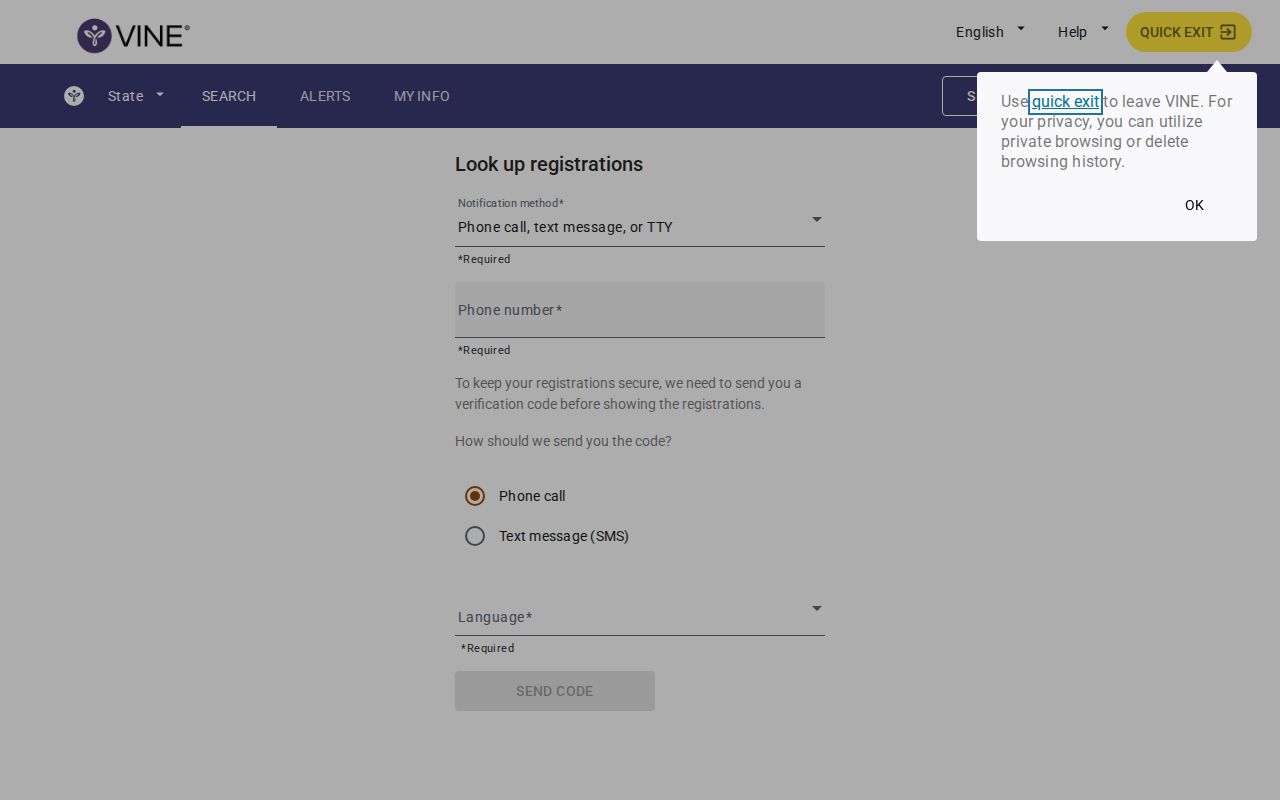
Enter no personal information on a sample screen. Use a secure contact method on the live service. Keep that contact information current, because blocked calls, full mailboxes, changed email addresses, and forgotten PINs can all interfere with delivery. When personal safety or a court deadline is at stake, never depend on a single automated notice.
VINELink Limits and How to Confirm
VINE data can lag a fresh booking. A blank result does not prove no arrest occurred. Recheck spelling, state, county, and identifying details, then compare the search with the county's recent-admit or current-confinement view.
VINELink is not a federal locator. Federal custody belongs in the BOP inmate locator, while immigration custody uses the ICE detainee locator. Neither system replaces a Lee County booking search.
The Lee County Citizen Connect portal lists (229) 759-6034. The sheriff's official page lists (229) 759-3334. It also lists the Criminal Justice Center. That address is 119 Pinewood Road, Leesburg. For sheriff-held documents, submit a trackable request through NextRequest, where Lt. Sean Getek is identified as records custodian. The official Citizen Connect booking page provides the county's current and recent booking controls.
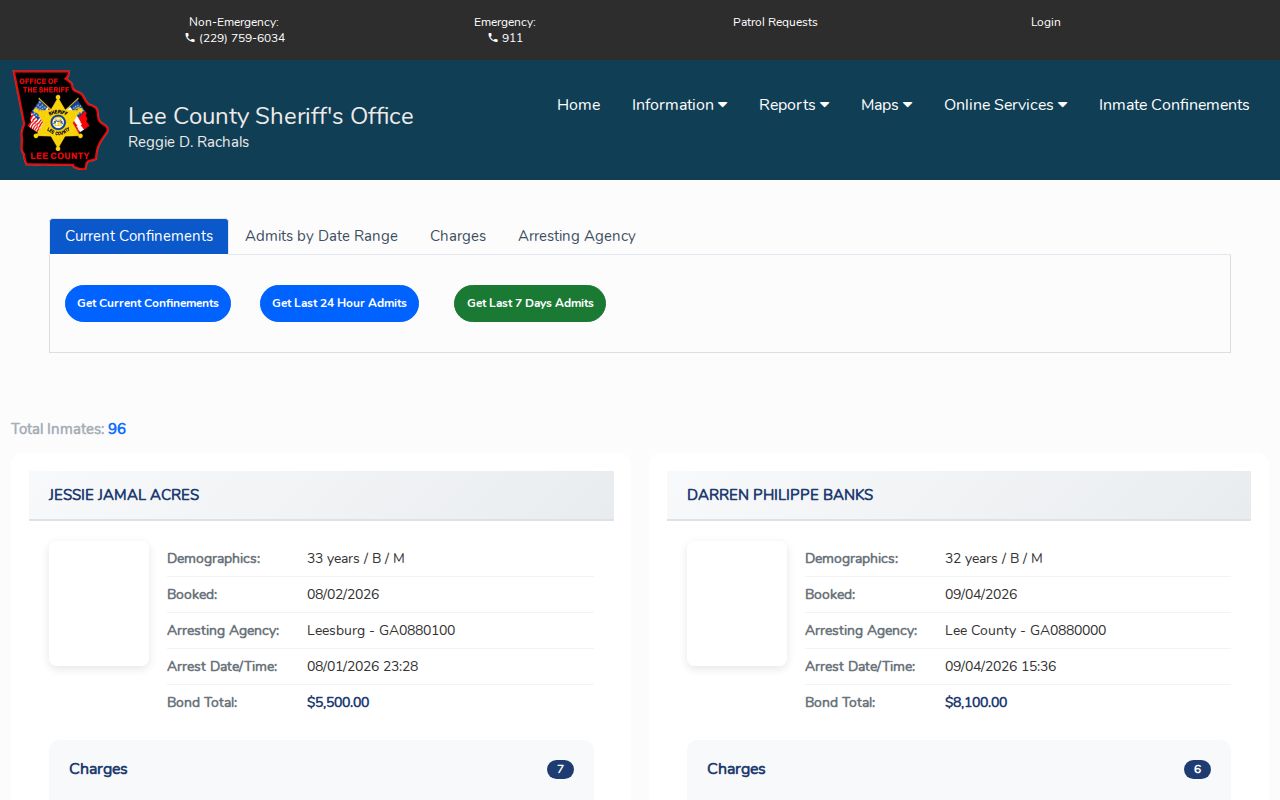
Confirm booking context with the county source before reading meaning into a VINE match or its absence.
Follow the Correct Custody System
Custody does not always stay local. Once a sentenced person moves to state prison, the right lookup becomes the Georgia Department of Corrections Find an Offender search, where photos appear only when available. A federal transfer points to BOP instead. ICE covers immigration detention. Each system answers a different question.
For the outcome after an arrest, courts hold the answer. Lee County Magistrate Court takes arrest and search warrants, bond hearings, and preliminary hearings, though it is not the court of record. Lee Superior Court and Georgia Courts eAccess are the routes for later stages of a case. Timing explains many confusing results. A name can show in Lee County's rolling booking window before VINE makes the record searchable. Someone released from the Criminal Justice Center can linger in a seven-day booking result while Current Confinements already drops that name. A transfer may also swap one facility name for another. Write down when each source was checked rather than trusting the newest-looking screen.
Common names need care. Match only the identifiers that official services provide. Never decide from a photo alone. Sometimes a booking photo shows. Sometimes a placeholder does. Citizen Connect alternates between the two. A missing image does not erase an arrest or custody record.
Use Alerts as One Safety Tool
A custody alert is a helpful tool. It is not a guarantee. Alerts cannot promise advance word on every move or event in Lee County. Keep your agency and court contacts close at hand, follow the instructions from Georgia VINE, and call emergency services any time real danger is present. A roster entry or a notification is never a reason to approach someone.
Wrong result? Start with the office that owns the fact. The Sheriff's records staff can explain a booking number, an admit or release entry, the arresting agency, a charge, a bond field, or any related public record. Questions about a disposition belong to the court. Registration and delivery problems belong to VINE support. Keeping these roles straight keeps you from asking an alert provider to fix a court outcome or a clerk to repair a subscription.
For a formal sheriff record, use NextRequest. Give a name, a booking number if you have one, and a narrow arrest or booking date range. The portal handles correspondence, status updates, estimates, responsive documents, and electronic delivery when offered. One limit matters. The sheriff does not keep Lee County E-911 records, and dispatch material moves through the county's separate request route.
Do not treat an arrest record or alert as a consumer report. Neither this material nor the linked public-record guidance serves decisions regulated by the Fair Credit Reporting Act.
Before you stop searching, note which question is still open. Was the person booked recently? Citizen Connect's rolling booking view answers that. Is the person still held? Check Current Confinements, and confirm by telephone when it matters. Did the person leave the jail? Compare the release field with the VINE event. What happened to the charge? That answer lives in the court record. Working source by source beats trusting any single screen as a full biography.
Lee County's countywide portal also keeps arresting-agency filters. Choose the Sheriff's Office, Leesburg Police Department, or Smithville Police Department. The filter shows where an arrest began, though the cities still share one county custody system. A city police arrest can become a county jail booking, then a VINE notification, then a court entry. Match the person and the dates at each stage.
Automated alerts earn their keep because custody can change at any hour. Still, a 24/7 service is not a pledge that every local data feed moves instantly. Keep the jail's official contact handy. Save your alert confirmation. When a decision turns on current status, go back to the live official sources.